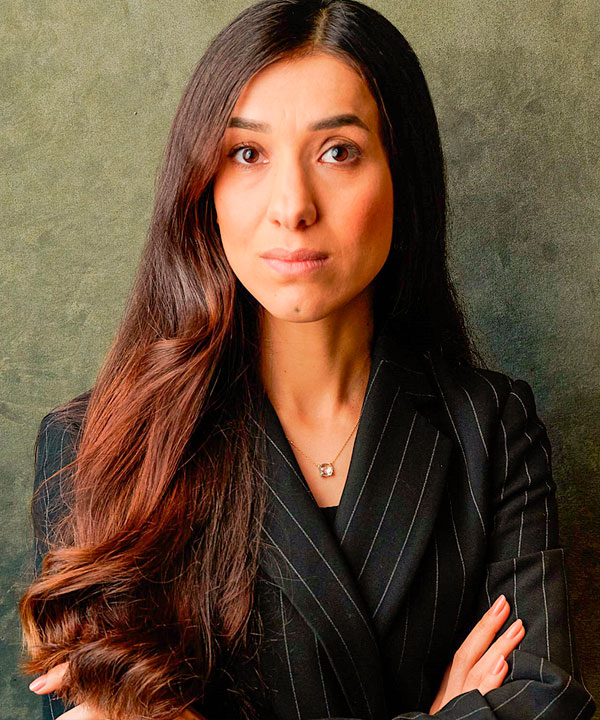
Nadia Murad
Nobel Peace Prize Laureate
Founder and President of Nadia’s Initiative

Founder and President of Nadia’s Initiative
WHY NADIA — WHAT AUDIENCES TAKE AWAY
Nadia Murad is a Nobel Peace Prize Laureate and one of the most influential forces reshaping how the world responds to conflict-related sexual violence. She has moved survivor-led justice and recovery from the margins to the center of global policy — changing the standard by which governments, international institutions, and legal systems are held accountable.
In 2014, Nadia was taken captive by the Islamic State (ISIS) during the genocide against the Yazidi community. After escaping, she chose to speak out — not to seek sympathy, but to force a global reckoning with the systems that allowed these crimes to happen and went unpunished.
What followed was not just advocacy — it was transformation. Nadia has driven fundamental shifts in international legal frameworks, pushed accountability mechanisms into existence, expanded access to reparations, and embedded survivor-centered approaches into institutional responses across multiple regions. Where there were gaps in the global system, she has worked to close them.
She has held heads of state, the United Nations Security Council, and governments to account — pushing them to act on justice for survivors and strengthen global responses to conflict-related sexual violence. Her leadership was instrumental in establishing the UN investigative mechanism UNITAD and securing the adoption of UN Security Council Resolution 2467 — milestones that have reshaped international law.
Nadia is the Founder and President of Nadia’s Initiative, a nonprofit organization dedicated to rebuilding communities in crisis and driving global advocacy for survivors of sexual violence. She has championed reparations access for survivors worldwide.
In 2016, she became the first United Nations Goodwill Ambassador for the Dignity of Survivors of Human Trafficking. In 2018, she was awarded the Nobel Peace Prize for her leadership in ending the use of sexual violence as a weapon of war.
Her work is grounded in an uncompromising principle: survivors must be at the center of the systems meant to protect them — not as symbols, but as leaders shaping law, policy, and recovery.



 Notari, Emanuela